Nothing here yet. Every maker starts somewhere.
Pick a starter kit with everything for your first cast, or let the beginner guides walk you through it.
Shop the starter kits Read the beginner guides
 By Mira Casteels
·
6 min read
Beginner
By Mira Casteels
·
6 min read
Beginner

The mould you cast into shapes everything that comes out of it, so getting it right matters as much as the mix. This guide walks you through choosing silicone moulds for Jesmonite®, from the types available to picking the right one for your project, plus how to demould, clean and care for your moulds so they keep giving you crisp results.
With hundreds of moulds to choose from, there is a shape for almost every idea, and a few simple habits will keep them working for a long time.
Jesmonite® is a water-based, two-part material: a mineral Jesmonite® base powder mixed with a liquid acrylic. It sets fairly quickly and captures fine detail, which is exactly where silicone shines. Flexible silicone flexes away from the cast, so you can release delicate edges and undercuts without cracking them.
Silicone also has a naturally non-stick surface, so you never need a release agent when casting Jesmonite® into silicone, which keeps your workflow simple and your casts clean. The flexibility that lets you demould easily is the same quality that makes silicone gentle on both your piece and the mould itself.
Because Jesmonite® AC100 is water-based, and silicone is inert, the two work together comfortably for indoor decorative casting: trays, coasters, vases, candle holders and other small homeware.
Start with the object you want to make, then work back to the mould. A few questions make the decision easy.
If you are browsing, it helps to shop by category. Our coaster and tray moulds are a natural first project, while candle holder moulds and vase moulds let you move into three-dimensional homeware. For smaller, quicker wins, the jewellery moulds are perfect for using up leftover mix. You can also browse the full range of silicone moulds in one place. Want a step-by-step for a specific project? See our guides to making coasters, trays, candle holders, vases and jewellery.
New to casting? An AC100 starter kit pairs the Jesmonite® base powder and Jesmonite® liquid with the essentials, so you can match your first mould to a ready-to-go mix.
One of the joys of casting Jesmonite® into silicone is how little preparation it needs. Because silicone is non-stick, no mould release agent is needed with Jesmonite®. Simply make sure the mould is clean, dry and dust-free before you pour.
Always mix to the exact ratio by weight. AC100 uses 1:2.5, one part Jesmonite® liquid to two and a half parts base powder, while the cement-based variants AC84 and AC730 use 1:5. To work out how much you need, most of our own mould product descriptions list the amount, or you can use the water trick: fill the mould with water, weigh it, add about ten percent, divide by two for the Jesmonite® liquid, then multiply that liquid figure by 2.5 for the Jesmonite® base. An online Jesmonite® calculator or the Jesmonite® app will do the same maths for you. For a full walkthrough, see our guide on how much Jesmonite® you need. Pour steadily, tap or gently vibrate the mould to release trapped air, and level the surface.
Jesmonite® AC100 is typically ready to demould after about thirty minutes, and it keeps getting stronger, reaching full cure after twenty-four hours. When it is firm enough to hold its shape, release it gently:
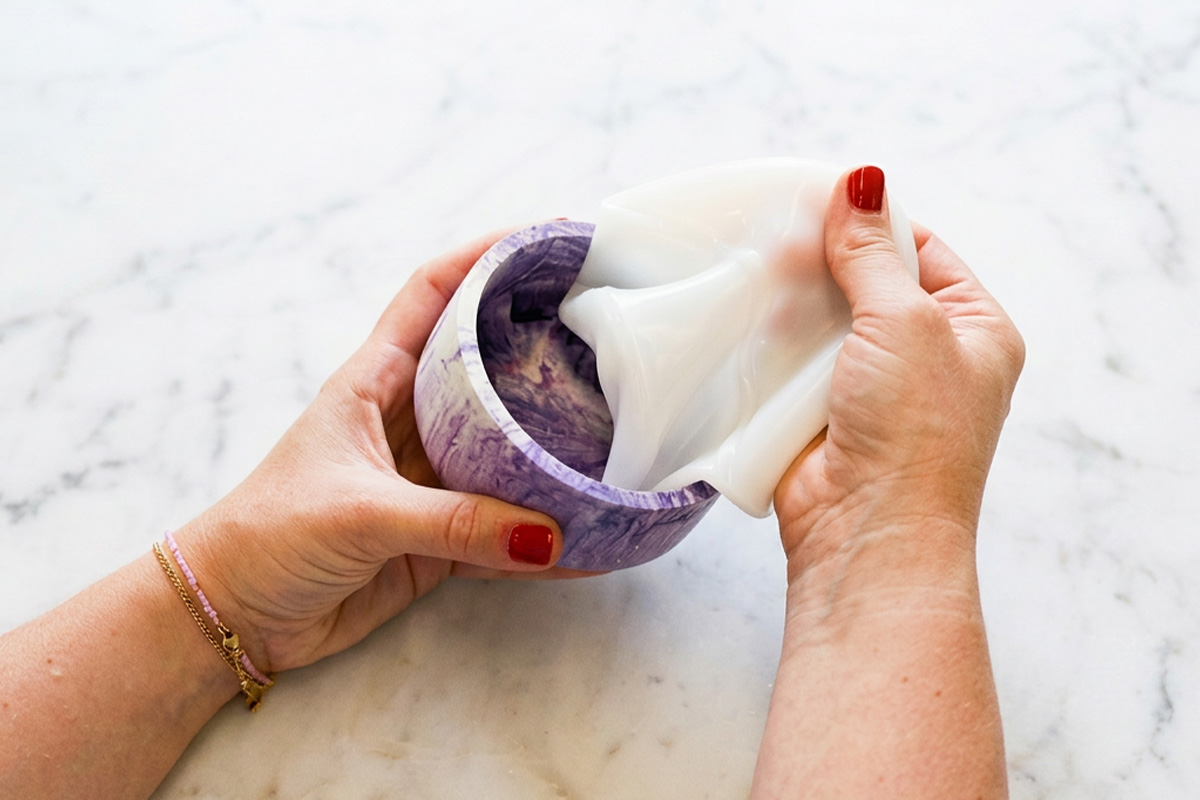
Never force a stuck cast or dig at it with a tool, as that is how both casts and moulds get damaged. Patience is the only technique you need.
A well-kept mould can produce dozens of clean casts, so a little care goes a long way. After demoulding, wash the mould in warm water with a drop of mild soap to remove any residue, then rinse and let it dry completely before storing. Warm water and mild soap is all most moulds need; for tougher marks (or cleaning your whole workspace), reach for our Jesmo Clean spray. Trapped moisture and leftover material are the main causes of dull or marked casts.
Avoid abrasive scourers and sharp tools, which scratch the silicone and leave marks on every cast that follows. A soft cloth or your fingertips are all you need. You can stack moulds to save space; just make sure nothing squashes them, because silicone can take a set and deform if it is bent or squashed under weight for a long time. Keep them out of direct sunlight and away from heat.
Above all, protect them from tearing. Silicone is tough but not indestructible, and a nick at the rim tends to grow with use. Handle by the body of the mould rather than stretching thin edges, and they will stay in service far longer.
There is no fixed number of casts, because lifespan depends on the mould, the detail, and how you treat it. Simple, flat moulds that are cleaned and stored properly can serve for a very long time, while fine, intricate moulds naturally wear at the detail sooner. Casting Jesmonite® into silicone keeps the surface clean, as there is no build-up of residue to degrade it.
You will know a mould is nearing the end of its life when casts start losing crispness, edges look soft, or small tears appear. Until then, gentle demoulding, careful cleaning and flat storage are what keep a mould producing sharp results pour after pour.
Ready to start casting? Explore the full collection of silicone moulds for Jesmonite®, pick the shapes that fit your next project, and pair them with the right mix to bring your ideas to life.

Everything from this guide in one basket: AC100 sets - 1750, with the recommended extras optional.


★★★★★ Rated Excellent on Trustpilot
No. Silicone is naturally non-stick, so Jesmonite® releases cleanly on its own without any release agent. Just keep the mould clean, dry and dust-free before pouring.
For AC100, typically around thirty minutes; AC84 takes about two hours and AC730 about four. Wait until the cast is firm enough to hold its shape. It continues to strengthen and reaches full cure after twenty-four hours, so if a piece feels reluctant to release, waiting a little longer makes demoulding easier and safer.
Wash in warm water with a little mild soap, rinse well, and let the mould dry completely before storing. Avoid abrasive sponges and sharp tools, which scratch the surface and mark future casts. A soft cloth is all you need.
Silicone moulds are versatile and work with a range of casting materials. Always check the guidance for the specific material you are using, follow its instructions, and keep the mould clean between different materials so residue does not affect your results.
Mira has walked hundreds of makers through their very first cast in the Gigacrea workshop. Part of the Gigacrea maker team.